
Good psychosocial risk management is not a separate discipline from safety. It is safety—applied to hazards that can harm mental health (and often physical health too). Under the model WHS framework, PCBUs have a duty to ensure workers and others are not exposed to risks to psychological or physical health and safety, so far as is reasonably practicable. [1]
What “good practice” looks like in Australia is therefore familiar: a repeatable process, genuine consultation, sensible evidence that you actually did the work, and regular review. That is the benchmark set out across Safe Work Australia’s psychosocial hazard guidance and its model Code of Practice, alongside Comcare’s regulatory guidance in the Commonwealth jurisdiction. [2]
The benchmark: psychosocial hazards are WHS hazards
Safe Work Australia defines psychosocial hazards as things at work that could cause psychological harm, and lists common examples such as job demands, low job control, poor support, lack of role clarity, poor organizational change management, bullying, harassment (including sexual harassment), violence and aggression, remote/isolated work, and poor physical environment. [3]
These hazards matter because they can create stress and, when stress is frequent, prolonged, or severe, it can cause harm. Safe Work Australia is explicit that stress itself is not an injury, but it can lead to psychological and physical harm over time. [4] Comcare similarly explains that psychosocial hazards are aspects of work that may cause psychological and physical harm by causing people to feel stress, and that harm becomes more likely when responses are frequent, prolonged, or severe. [5]
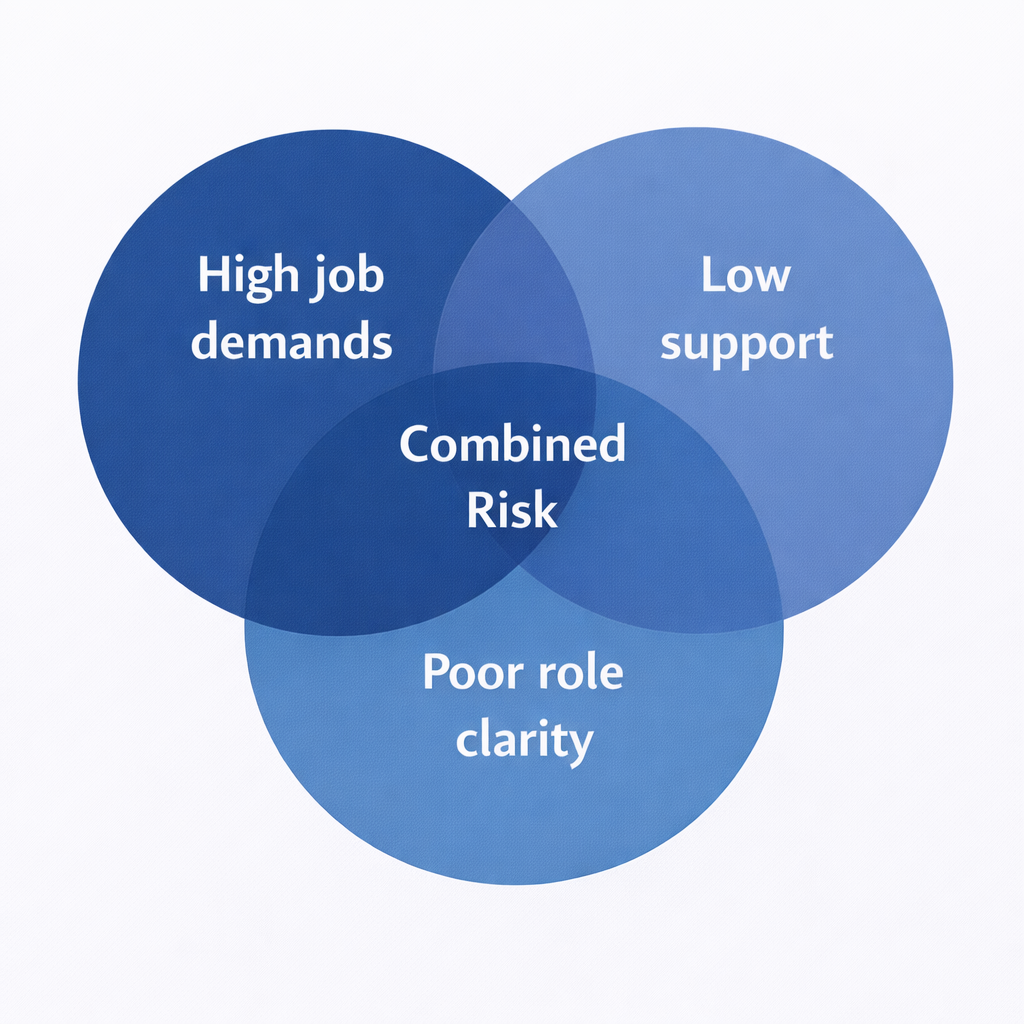
“Good practice” also means thinking systemically, not in single-hazard silos. Safe Work Australia warns that psychosocial hazards can interact and combine to create new or higher risks, and Comcare notes that workers are often exposed to combinations of hazards, with harmful outcomes often driven by how hazards cluster together. [6]
Finally, good practice in Australia recognizes jurisdictional reality. Safe Work Australia’s model Code of Practice provides practical guidance, but it only has legal effect in a jurisdiction if adopted/approved there—so the benchmark is: follow the same logic everywhere, while checking the local legal instruments that apply to your workplace. [7]
The system: the same four-step cycle you already use for physical safety
Safe Work Australia’s guidance is deliberately simple: psychosocial risks should be managed using the same risk management process used for physical hazards—identify hazards, assess risks, implement control measures, and review those controls—done in consultation with workers and any HSRs. [8]
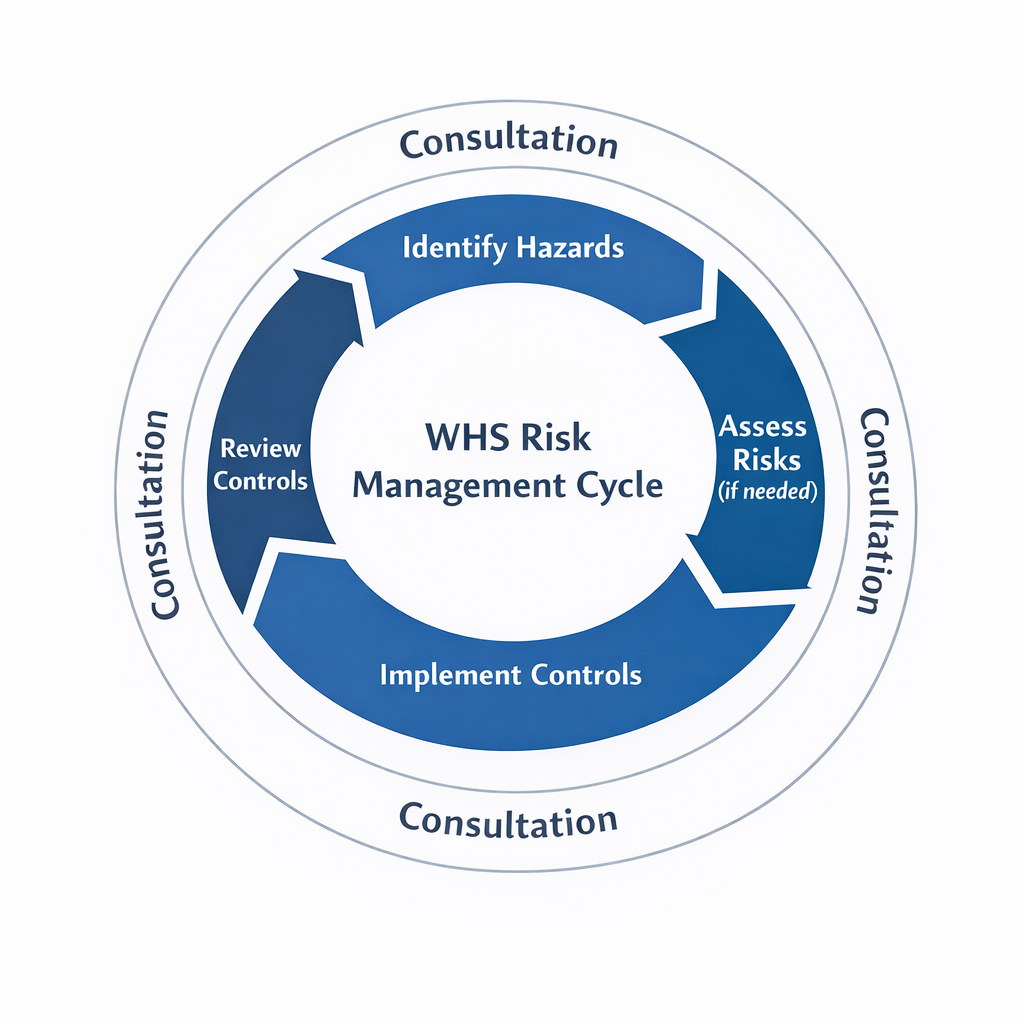
The model Code of Practice reinforces the same message: to meet WHS duties you must eliminate or minimize psychosocial risks so far as reasonably practicable, and—“just as for any other hazard”—you apply the standard risk management process (identify, assess if necessary, control, review), with consultation supporting every step. [9]
Two clarifications in the Code are especially useful for “not overcomplicating it”:
First, risk assessment is not always mandatory as a work step. If the risks and controls are already well known, the Code notes that the assessment step may not be necessary—you can implement known effective controls and then check whether they work. [10]
Second, this is meant to be planned and integrated into normal work planning, not bolted on after problems occur. The Code frames risk management as ongoing and notes that considering psychosocial hazards early (including in major change) prevents costly rework and allows more effective controls. [11]
Consultation: not a checkbox, but the engine of the process
Under Safe Work Australia’s summary of PCBU duties, consultation is not an “extra”—it is part of how you meet the duty. The PCBU duties page sets out that consultation means sharing relevant information, giving workers a reasonable opportunity to express views and contribute to decisions, taking those views into account, and advising workers of outcomes in a timely way. [1]
The model Code further emphasizes that you must consult with workers when assessing risks or making decisions about psychosocial risks, including selecting and implementing control measures. [12] It also stresses timing: consultation on changes that may affect WHS should occur as early as possible, which is particularly relevant for restructures, role redesign, workload shifts, technology changes, performance management processes, and new monitoring practices. [13]
Comcare’s regulatory guide (for the Commonwealth jurisdiction) makes the same principle explicit in the psychosocial hazard context: when identifying psychosocial hazards, PCBUs must consult with workers likely to be directly affected, and that includes any health and safety representatives who represent the affected workers. [14]
A practical “good practice” standard here is not “everyone agrees.” It is that workers (and HSRs) can see that you asked, listened, used their input, and closed the loop—and that this influenced what hazards you identified and what controls you chose. That expectation is built into both the consultation duties described by Safe Work Australia and the “supported by consultation” framing in the Code. [15]
Evidence: “show your work” without drowning in paperwork
Good psychosocial risk management creates a trail of evidence because it is a management system, not a one-off activity. The model Code is explicit that you should record your risk management process and outcomes (including consultation), so you can demonstrate you have met WHS duties and so you can monitor and review hazards and controls over time. [16]
The Code is also practical about what evidence can look like. It says records may include outcomes of consultation, hazards identified, how risks were assessed, what control measures were implemented, and what training was provided. [16] It also recognizes proportionality: you should choose a method of recording that suits your circumstances (for example, using a risk register such as the example in Appendix C), and you may keep high‑level information in a general register where confidentiality is a concern. [17]
Importantly (and reassuringly), the Code frames documentation as demonstration, not bureaucracy for its own sake: an inspector may ask to see records relating to the risk management process, and if you do not have a written record you will need to demonstrate by other means how you met your duties. [18] This is why “good practice” is not perfection; it is being able to show a reasonable, consultative process and the decisions you made. [19]
A proportionate evidence set typically includes:
- a current psychosocial hazard/risk register or equivalent record (with owners and due dates), consistent with the Code’s suggested approach and Appendix C template [20]
- notes of how you identified hazards (including reviewing relevant information and records like complaints, incident data, hours worked, absenteeism/turnover, inspection reports, and committee records) [21]
- evidence of consultation (who you consulted, how, what themes emerged, what decisions changed as a result, and what you communicated back) [22]
- control implementation records (e.g., role clarity artifacts, resourcing decisions, workflow changes, supervision arrangements, training rollouts) tied back to the hazards being controlled [23]
- review triggers and outcomes (what you checked, what indicators you monitored, what you changed and why). [24]
Controls: focus upstream on job, work design, and systems
In both Safe Work Australia and Comcare guidance, the control standard is the same as other WHS risks: eliminate the risk if reasonably practicable; if not, minimize it so far as reasonably practicable. [25] The Safe Work Australia PCBU duties page also explains what “reasonably practicable” means at a high level: what is reasonably able to be done considering factors such as likelihood and consequences, what is known about the hazard and controls, and controls available, with cost relevant only after those factors. [1]
Where psychosocial risk management gets unnecessarily complicated is when controls are treated as “programs” rather than “risk controls.” The model Code points back to the controlling idea: psychosocial hazards often arise from the design or management of work, systems of work, and workplace interactions or behaviors, and your controls should therefore often be upstream—changing the way work is designed, allocated, supported, supervised, and changed. [26]
The Safe Work Australia PCBU duties page also sets out “relevant matters” the PCBU must have regard to when deciding controls, including duration/frequency/severity of exposure, how hazards interact, work and system design, workplace conditions, workplace behaviors, and the information/training/supervision provided. [1] This is a strong indicator of what “good controls” look like in practice: controls are rarely just a single training session or a poster; they are commonly changes to work design, resourcing, supervision, and systems. [27]
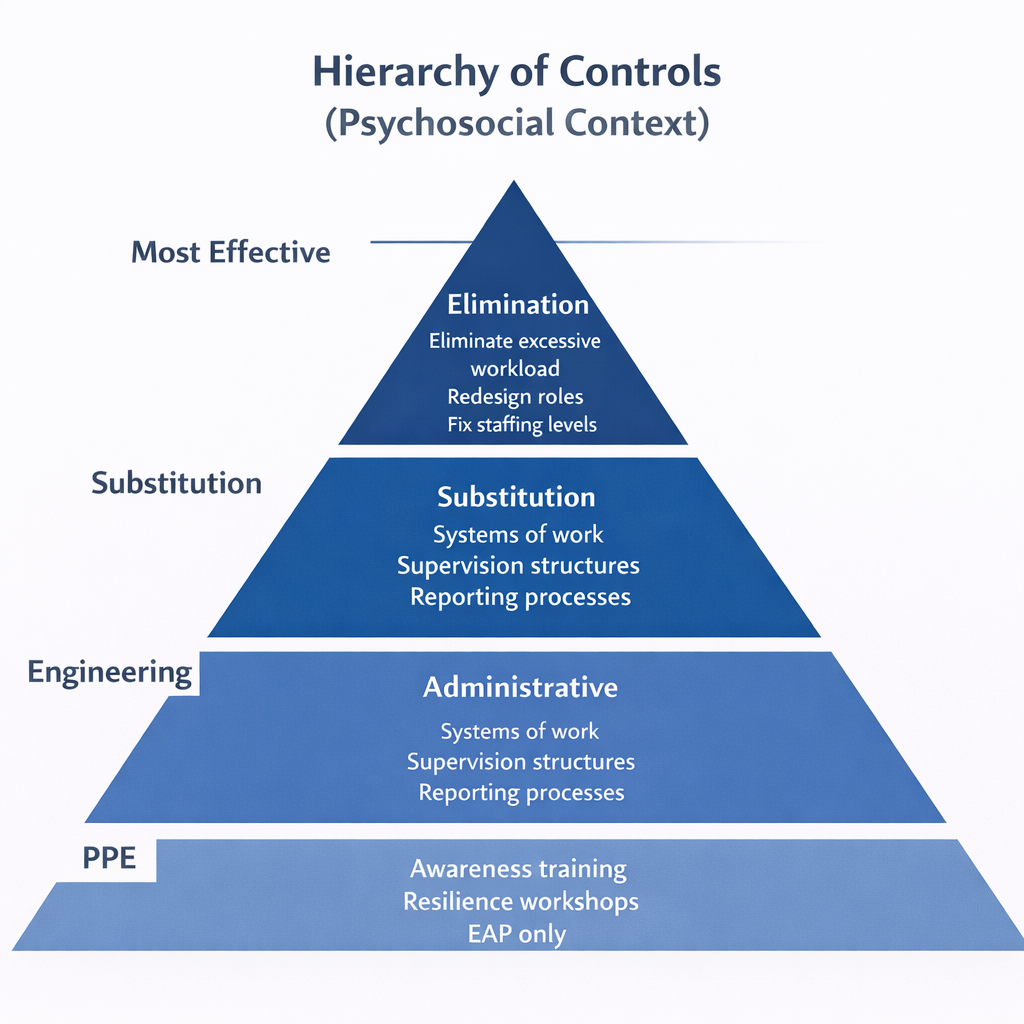
In the Commonwealth jurisdiction, Comcare’s regulatory guide goes further in a way that can sharpen “good practice” expectations: elimination must always be considered first, and if elimination isn’t reasonably practicable, then the hierarchy of controls must be followed (substitution, isolation, engineering controls, then administrative controls, then PPE). It also notes that administrative controls and PPE are less reliable on their own because they rely on human behavior and supervision. [28]
A calm, practical benchmark for “good controls” therefore looks like:
- Work design controls first (job demands, staffing levels, scheduling, meaningful breaks, realistic timeframes, role clarity, matching tasks to capability), because Safe Work Australia and Comcare both situate hazards in work design/management and exposure patterns. [29]
- System controls (how work is planned, how change happens, how performance concerns are handled, how workers are supported and supervised, how harassment/bullying reports are handled, how you prevent repeated harmful behavior), consistent with the Code’s focus on systems of work and safe work systems/procedures. [30]
- Environment and interface controls (layout, safe means of entry/exit and facilities, and other workplace condition factors), reflecting the “workplace conditions” and “plant/structures” factors in the relevant-matters tests. [31]
- Training and supervision as supporting controls—important, but not a substitute for upstream design changes, which is consistent with the hierarchy-of-controls emphasis and the Code’s framing of training/instruction/supervision as part of the control decision. [32]
Psychological safety: a helpful enabler, not the compliance mechanism
Psychological safety is best understood as a climate that makes it easier for people to speak up. In Amy Edmondson[33]’s foundational work, team psychological safety is defined as a shared belief that the team is “safe for interpersonal risk taking,” and includes confidence that people won’t be embarrassed, rejected, or punished for speaking up. [34]
That matters for psychosocial risk management because consultation is legally and practically central: workers need to be able to raise concerns, describe what’s happening in their work, and participate in decisions about controls. Safe Work Australia’s consultation description explicitly expects workers can express views, raise WHS issues, contribute to decisions, and be informed of outcomes. [1] The model Code also frames consultation as required across the process and uses consultation outcomes as inputs to review decisions, such as when consultation indicates a review is necessary. [11]
But psychological safety does not replace WHS risk management. Safe Work Australia draws a clear distinction between WHS controls and wellbeing initiatives: wellbeing activities may have benefits, but they do not protect workers from harm from psychosocial or physical hazards, because WHS is about preventing harm from the work. [35]
So the practical benchmark is:
Psychological safety is supportive infrastructure—it helps you hear about hazards early, consult properly, and review controls using real worker feedback. [36]
Psychosocial risk management is the safety system itself—identify hazards, assess when needed, implement effective controls, keep them maintained, and review them when triggers occur. [37]
[1] [15] [22] [27] [31] [32] [33] [36] – PCBU Duties | Safe Work Australia
[2] [8] [37] Mental health – Managing risks | Safe Work Australia
[3] [4] [6] [25] [29] – Psychosocial hazards | Safe Work Australia
[5] About psychosocial hazards | Comcare
https://www.comcare.gov.au/safe-healthy-work/prevent-harm/psychosocial-hazards/about-psych-hazards
[7] Model Code of Practice: Managing psychosocial hazards at work | Safe Work Australia
https://www.safeworkaustralia.gov.au/doc/model-code-practice-managing-psychosocial-hazards-work
[9] [10] [11] [12] [13] [16] [17] [18] [19] [20] [21] [23] [24] [26] [30] safeworkaustralia.gov.au
[14] [28] Regulatory guide – Managing psychosocial hazards | Comcare
[34] web.mit.edu
[35] – Differences between WHS and wellbeing | Safe Work Australia